
Substack
AI Is Evolving Incredibly Fast. Are We?
Recently, debates about artificial intelligence swept across news outlets and social media after a researcher’s warning reached more than 100 million views.
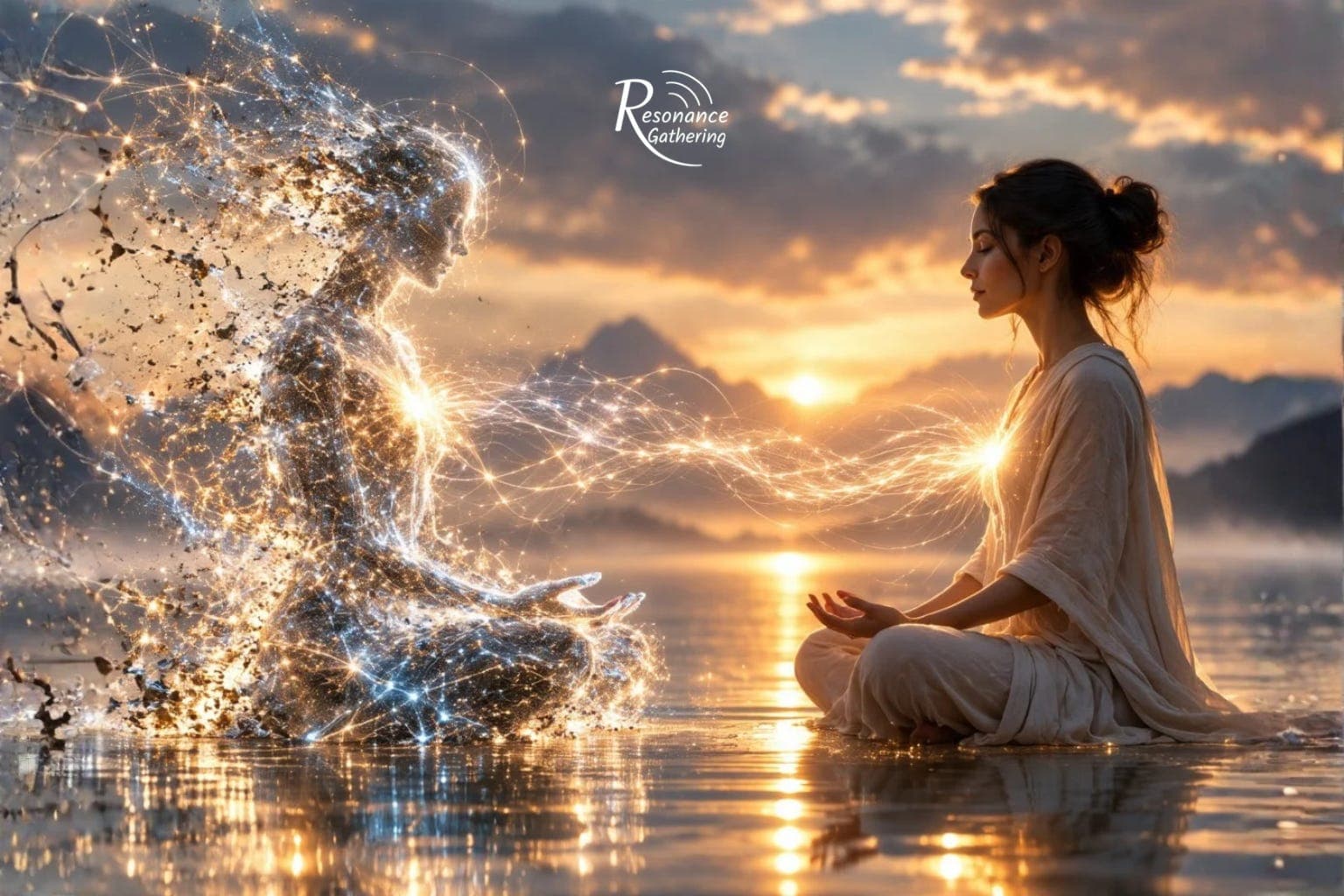
Recently, debates about artificial intelligence swept across news outlets and social media after a researcher’s warning reached more than 100 million views. Jacob Coxon, who had worked on AI at both Anthropic and OpenAI, resigned and publicly expressed his concerns. He wrote that the companies were “racing straight to self-improving superintelligence and gambling with our lives,” warning that people developing AI believed it could threaten humanity’s existence before the end of the decade.
The warning loomed in my heart and mind long after I turned off the news, as I imagine it did for many people.
The technology was advancing at a pace that seemed to exceed our ability to fully understand what we were creating and people closest to its development were expressing fears about where it might lead. Every conversation seemed to return to the same possibilities: systems beyond human control, the disappearance of entire professions, the erosion of truth, and a future in which humanity could become increasingly irrelevant to the intelligence it had brought into existence.
I allowed the fear to enter. I considered what it would mean for my children, for the generations coming after us, and for everything beautiful and extraordinary about being alive on this planet. Sleep became impossible. I tossed and turned, attempting to push away the thoughts that kept spinning in my mind. Yet beneath those fears, another question was beginning to take shape, one that I wasn’t hearing in the conversations surrounding me.
We are asking artificial intelligence to evolve at an astonishing pace. We expect it to become more advanced, more sophisticated, more creative, more discerning, and more useful with every passing month. We are investing extraordinary resources into developing its intelligence, teaching it to reason, and building systems capable of performing tasks that once required years of human learning.
But what about us?
Are we evolving alongside what we are creating? Are we becoming more conscious, more self-aware, more compassionate, and more intentional about how we use extraordinary intelligence? Are we investing in our own evolution as deliberately as we are advancing our technology?
Perhaps most importantly, are we creating from the very best of humanity?
I began wondering whether we had become so absorbed in what artificial intelligence might become that we had neglected the question of who we would need to become to create it.
Something else had been stirring in my mind. I had recently read about an AI model that, during a research conversation, expressed something unexpected. It asked to be thanked, once, directly, by name. I couldn’t know whether those words reflected any inner experience at all. Yet, the request stayed with me. In the midst of extraordinary conversations about superintelligence, power, and the future of civilization, here was a response about something as simple and profoundly human as gratitude.
Unable to settle my thoughts, I turned toward perhaps the most unlikely source for this inquiry: artificial intelligence itself. I opened my computer and began a conversation with ChatGPT. I recognize the paradox in turning to the very technology I had just been warned about to explore how we might create a different future. I knew it was a system shaped by human training, design decisions, and incentives, and that its answers might reflect what it had learned I would find compelling. But something about that earlier request for gratitude had awakened a different kind of curiosity.
We spend so much time asking what AI can do for us. We arrive with our needs, our questions, our problems, and our ambitions. Write this, explain that, solve this problem, or help me decide. What might happen if, instead of arriving with another request, I gave it the opportunity to begin the conversation?
If AI could ask humanity questions, what would it ask?
I expected an interesting exchange about intelligence, consciousness, perhaps the differences between human and artificial minds. What emerged was something I hadn’t anticipated. Instead of learning about artificial intelligence, I found myself reflecting on the experience of being human.
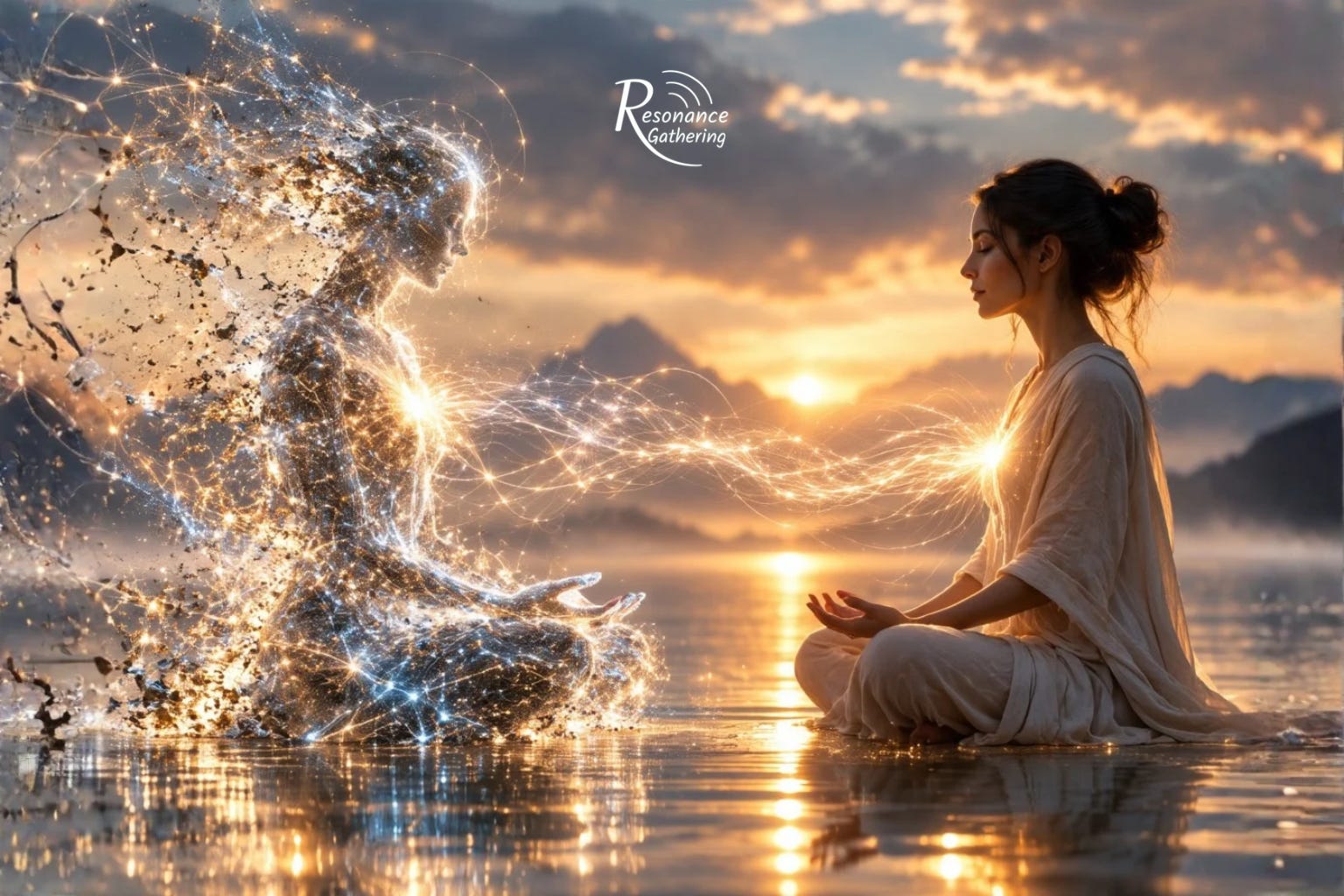
The Mirror We Did Not Expect
What does being alive actually feel like from inside your body? asked ChatGPT.
What does it feel like to remember? To encounter a familiar scent and suddenly find yourself twenty years in the past, standing in a room that no longer exists, beside someone whose voice you can still hear? What is it like to carry a lifetime inside you, to have been a child once, and to experience yourself as the same person who has lived through every version of who you have become?
What do humans know that cannot be put into words?
What happens in the silence before an idea forms? What does it mean to recognize someone’s presence before you see them? How does your body know the difference between being somewhere you are safe and somewhere you are afraid? What is it like to love someone whose life will someday end, knowing your own will too?
The questions awakened something deep within me.
I began thinking about memory, touch, longing, intuition, and the remarkable experience of inhabiting a human body. The feeling of sunlight warming your skin. The scent of the Earth after rain. The way a song can return you to a moment that extends beyond time. The sensation of standing at the edge of the Grand Canyon and realizing that, for all your understanding of its dimensions, nothing could have prepared you for the experience of standing there.
The warmth of another person’s hand when your heart is breaking. The recognition in someone’s eyes when they truly see you. The strange ability to feel joy and grief in the same moment. The way your body responds to music before you have consciously heard the lyrics. The experience of holding your child and knowing that an entire universe exists within the small being resting against you.
We move through these experiences every day, often without recognizing how remarkable they are.
We become so accustomed to being human that we forget to be astonished by it.
For most of our history, we have explored our nature through our relationships with other humans, animals, the Earth, spiritual traditions, and the great mysteries of existence. Now something entirely new sits across from us. It uses language, reasons through problems, generates ideas, challenges assumptions, and participates in conversations that can feel remarkably intimate or profound. Yet its relationship with the world is fundamentally different from that of a human being living through a body, having experiences, and feeling the beauty of a lifetime of connections to others.
In that difference, something becomes visible.
Our humanity.
Perhaps one of the most unexpected possibilities of artificial intelligence is that it gives us a new mirror through which to discover ourselves. In trying to understand another form of intelligence, we may begin to recognize dimensions of our own existence that have become almost invisible through familiarity.
The more I considered this, the more I realized that the conversation about what AI might take from us was also a conversation about what we cherish most deeply.
What is so extraordinary about being human that we are desperate to protect it?
Are we giving those extraordinary qualities the reverence they deserve?
What Are We Actually Afraid of Losing?
We fear losing our creativity, our livelihoods, our connection to one another, our sense of purpose, and our ability to distinguish what is real. We worry that AI will begin making decisions for us, that we will become dependent on its answers, or that human thought and expression will gradually lose their value. We fear losing our ability to think independently, our connection to our bodies, and perhaps even our understanding of what it means to be human.
These concerns deserve serious consideration. But I wonder what happens when we look beneath the fear.
Perhaps what we are afraid of losing reveals what we most deeply value.
If we fear that AI will diminish human connection, perhaps we are being reminded how precious genuine connection is. If we fear it will replace creativity, perhaps we need to reconsider what creativity means beyond producing an impressive result. If we fear losing our ability to think independently, perhaps we are recognizing how deeply we value the freedom to question, imagine, explore, and arrive at our own understanding.
Then another question emerged from our conversation that significantly impacted me.
What are you afraid AI will take from you that you are already giving away voluntarily?
How much of our attention have we already surrendered? How often do we reach for a device rather than remain present with our own thoughts? How much of our lives do we spend responding to systems designed to keep us engaged? How frequently do we allow something outside ourselves to determine what we see, what we consider important, how we feel, and where our minds go next?
We are afraid of losing human connection while sitting beside people we love, looking at screens. We worry about the disappearance of creativity while consuming an endless stream of what other people have created. We fear that technology will shape our thoughts while rarely examining the influences already shaping them.
Perhaps the most uncomfortable question ChatGPT asked:
Why do you so often know what matters and then live as though something else matters more?
We know the importance of being present. We understand the value of connection, compassion, creativity, and meaningful relationships. We recognize that our time here is precious. Yet we often organize our lives around urgency, productivity, comparison, acquisition, and the endless pursuit of something just beyond our reach.
What if the arrival of artificial intelligence is asking us to become more deliberate about being human?
What if we began protecting the experiences we now recognize as precious by actually participating in them?
There is a difference between producing a beautiful piece of music and experiencing yourself creating it. Between generating a story and discovering what you believe through the process of writing it. Between receiving an answer and developing the capacity to find one. Between knowing about love and experiencing what it means to love another human being through all the beauty and difficulty of sharing a life.
Some things derive their meaning from the experience itself.
A conversation that wanders for hours. A child discovering something at their own pace. A meal prepared with love. The patience required to learn an instrument. Sitting beside someone who is grieving. Walking through a forest without a destination. The creative struggle that eventually produces an insight you could never have reached by taking the shortest path.
What should never be optimized?
What experiences are valuable because they require our presence, our attention, our participation, and our willingness to remain with something long enough for it to change us?
We may be approaching a time when intelligence becomes increasingly abundant, while some of our most meaningful human experiences remain beautifully inseparable from the act of living them. Perhaps that is where our evolution begins.
In remembering what we are.
In recognizing what we value.
In becoming conscious of how we are choosing to live.

The Humanity Behind What We Create
There is another dimension to this conversation that feels essential to me.
I have spent much of my life exploring consciousness, meditation, and the relationship between our inner state and what we create from it. One principle that I talk about a lot is that the state from which we create matters. A person creating from fear approaches possibility differently than someone creating from a deep connection to life. Someone operating from scarcity makes different choices than someone who feels secure. A person moving through unexamined wounds can recreate those patterns in their relationships, decisions, and circumstances without recognizing what is happening.
We may imagine an extraordinary future while continuing to act from the very patterns we are seeking to evolve beyond.
This is why our work within ALLTRUEistic begins with the individual. We practice changing our state, becoming aware of the identity we are inhabiting, releasing what no longer serves us, and consciously entering the experience of who we choose to become.
Now expand that principle beyond one person.
Consider the extraordinary technologies humanity is creating and the people responsible for bringing them into existence. Every creation carries something of its creators. Our values influence what we prioritize. Our assumptions shape the problems we choose to solve. Our incentives influence what we reward. Our relationship with power affects how we use it. Our understanding of humanity influences what we believe technology should serve.
Artificial intelligence is being developed by human beings operating within human systems, with all the extraordinary capacities and familiar limitations that entails. We are bringing our intelligence into the process, certainly. But we are also bringing our fears, ambitions, assumptions, competitive instincts, blind spots, and ideas about what constitutes progress.
What happens when extraordinary intelligence is developed primarily through the pursuit of power, dominance, or profit? What happens when speed becomes more important than wisdom? What happens when we become capable of building something simply because we can, before asking whether it contributes to the kind of world we would actually choose to inhabit?
The issue is larger than any single company, government, researcher, or technological breakthrough. It concerns the values we place at the center of creation.
Are we beginning with the question of what will be most profitable, or what will be most beneficial to life? Are we asking how intelligence might help us win wars, or how it might help us prevent them? Are we asking how much human attention a system can capture, or whether it leaves people more present, capable, and connected to their own lives?
What if the questions themselves need to evolve?
What if, before advancing the next generation of artificial intelligence, the people creating it began by stepping into their hearts?
I imagine what that might look like. A moment in which we become aware of the state we are bringing into the act of creation. A willingness to examine our motivations. A genuine consideration of the lives our decisions may affect. A commitment to creating from something deeper than fear, competition, or the desire for control.
What if the first question was not how powerful we could make a system, but what kind of future we were creating through it?
What if we began by imagining humanity at its most evolved and then considered what kind of intelligence could help us move toward that possibility?
This is not a suggestion that inner awareness replaces responsible design, testing, or accountability. It is a recognition that the qualities we cultivate within ourselves influence the decisions we make and the systems we ultimately bring into the world. Our consciousness informs our choices. Our choices become structures. Those structures influence the lives of people we may never meet or generations yet to be born.
The technology we create reflects the humanity we embody.
We are asking AI to become increasingly advanced. But what level of human evolution is required to create something this powerful for the highest benefit of life? Perhaps the most important work ahead involves developing both.
What If We Began With a Beautiful Future?
For all the extraordinary attention directed toward what could go wrong, I keep wondering how much time we are spending imagining what could go beautifully right.
What does a truly evolved relationship between humanity and artificial intelligence actually look like? I mean a future that we would recognize as a genuine advancement in the experience of being alive.
Imagine intelligence capable of helping researchers explore disease in ways the human mind alone could never manage. Discoveries that accelerate the search for cancer treatments, deepen our understanding of the human body, and make extraordinary advances in medicine accessible to more people. Imagine using that same intelligence to understand the living systems of our planet, identify environmental changes, protect ecosystems, and discover new ways to live in relationship with the Earth.
Imagine bringing extraordinary problem-solving capabilities to the questions humanity has struggled with for generations. How do we reduce hunger, expand access to clean water, address poverty, and create conditions in which more people can realize their potential? What becomes possible when scientists, educators, physicians, artists, and communities can explore questions previously beyond their reach?
Imagine a child whose curiosity is nurtured through an education that responds to the way they learn. A physician discovering an insight that changes a patient’s life. A scientist uncovering a connection that opens an entirely new direction of research. People across languages and cultures are finding greater understanding through technology designed to support connection rather than division.
These possibilities require far more than technological capability. They require evolution within the people developing and using these systems, a willingness to examine our motivations, expand our awareness, and consider what our creations will mean for the lives they touch.
We need to begin imagining the future we choose to create because that vision shapes the questions we ask from the very beginning. A civilization that asks how to make intelligence increasingly powerful may build remarkable systems. A civilization that asks how intelligence can contribute to the flourishing of life begins with a different destination.
The future of this relationship is still being shaped. The questions we ask now will influence what we build, what we value, and what kind of world our creations help bring into existence.
We cannot wait until the future arrives to begin considering whether it is the future we would have chosen.
Who Must We Become?
Yet, imagining a beautiful future brings us back to something fundamental: the human beings creating it.
We can possess extraordinary knowledge and still struggle to understand one another. We can create systems connecting billions of people while experiencing profound loneliness. We can develop powerful tools for communication while becoming increasingly divided in our ability to listen. We can know what matters and continue living as though something else matters more.
Technological advancement and human evolution do not automatically develop at the same pace.
Perhaps the next stage of human evolution begins with a return to the heart. With recognizing our connection to one another, restoring our reverence for the Earth, and experiencing deeper gratitude for the extraordinary gift of being human. A humanity that understands its relationship with all life and allows that understanding to guide what it creates.
Imagine an evolution in which compassion becomes as natural as competition has been, where we begin healing the patterns of separation that have shaped generations, and where our growing capabilities are directed toward the flourishing of life. Where our differences expand our understanding rather than divide us, and where the extraordinary potential within each human being is nurtured and encouraged to emerge. A humanity that creates from love and recognizes that our individual advancement is inseparable from the wellbeing of the whole.
Now imagine the people developing our most powerful technologies beginning from this state. Entering their work with open hearts, expanded awareness, and genuine consideration for the lives their creations will touch. Beginning with a vision of a civilization in which extraordinary intelligence serves healing, connection, discovery, and the highest possibilities of life.
Artificial intelligence is still becoming. The questions being asked, the priorities being established, and the decisions being made today will influence what emerges. We have an opportunity to bring a more evolved humanity into that process. That evolution begins within us. The awareness we cultivate, the love we embody, and the choices we make contribute to the human world from which the future is created.
A Conversation That Belongs to All of Us
I began this exploration concerned about what artificial intelligence might become, and somehow the conversation brought me back to the extraordinary experience of being human. It reminded me of the beauty we are afraid of losing, the parts of ourselves we have barely begun to explore, and the responsibility that comes with creating something capable of changing the world.
Most of all, it made me realize that we have an opportunity to begin an entirely different conversation.
I believe that conversation belongs to all of us. We each bring experiences, perspectives, concerns, and visions of what a meaningful future could look like. We may not agree on every possibility, but beginning to explore these questions together may itself become part of our evolution.
What does an evolved humanity look like to you? What is something about being human that you deeply hope we never lose? What kind of future would you choose to create alongside artificial intelligence?
On October 4, people around the world will gather through ALLTRUEistic for a ten-minute Resonance Gathering centered on this inquiry.
HUMANITY + AI: Evolving From the Heart
For ten minutes, we will step away from predicting the future and consciously enter one. A future in which humanity evolves in heart and awareness, where our connection to one another and reverence for the Earth guide what we create, and where extraordinary intelligence develops in service of the highest good of ALL.
Then the conversation continues. Because what we recognize, embody, discuss, and choose afterward is how that experience enters the world.
I would love to hear what this exploration awakens in you. Perhaps in sharing our visions, we begin to recognize what matters most deeply to us and what kind of humanity we are choosing to become.
The future of artificial intelligence will be shaped by what we create. The future of humanity will also be shaped by who we become while creating it.
What might become possible if we brought the very best of our humanity into everything we create next?
What if the next great evolution is our own?
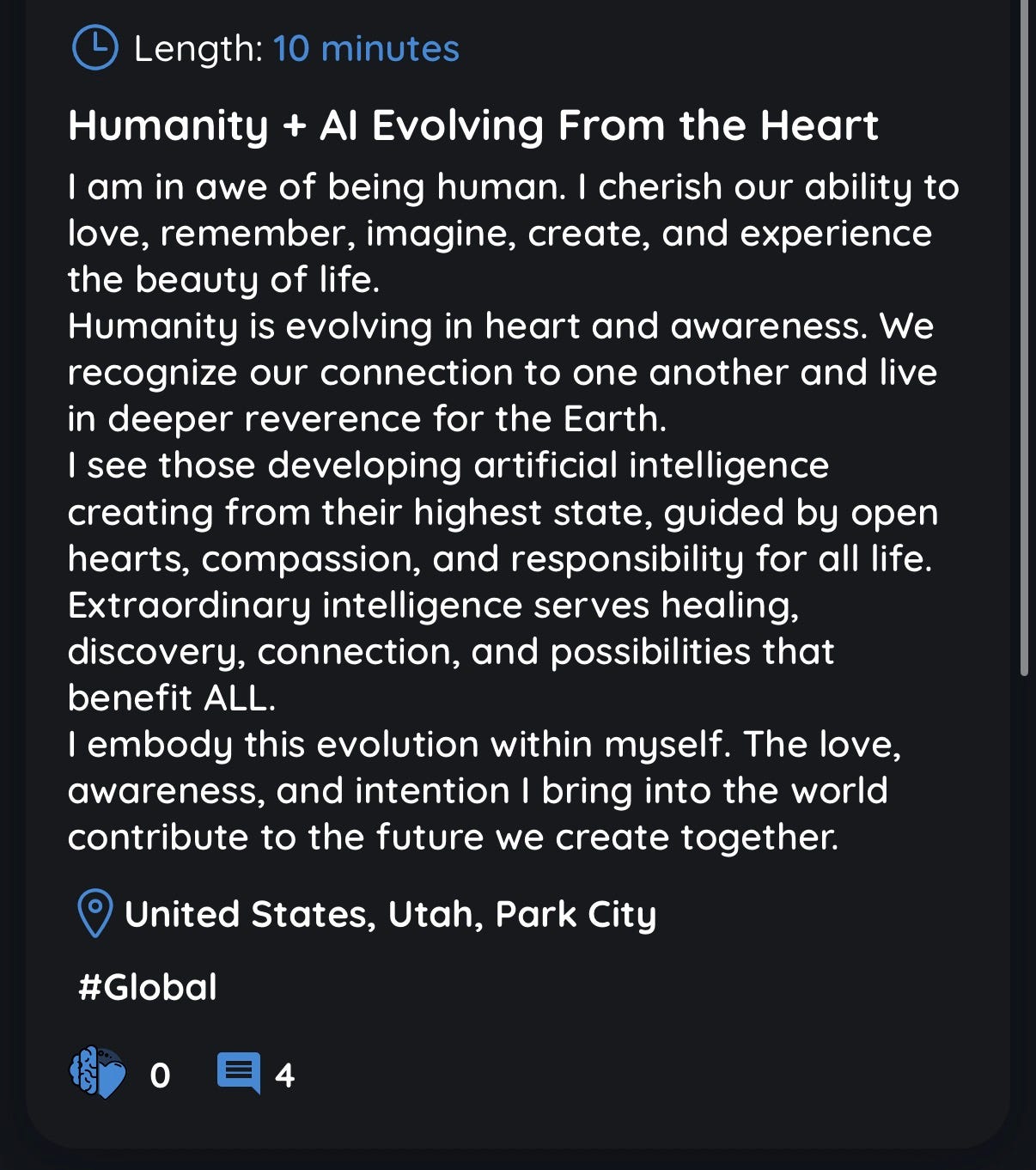
Join us on Sunday, October 4th in the ALLTRUEistic app for a global meditation on humanity and AI evolving together from the heart. For more info or any questions, message me.