
Substack
Gratitude Before the Reason
I am so grateful.
I am so grateful. My heart is filled with so much gratitude. I cannot explain how much gratitude I feel.
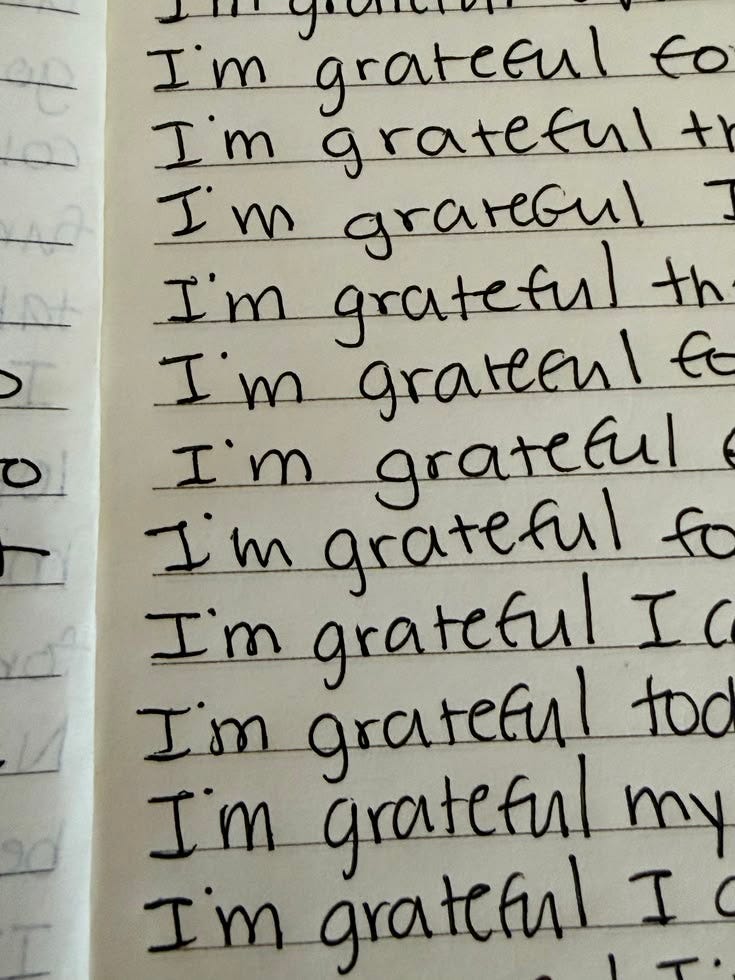
Those were the words that opened every page of my journal and this day was no different.
I sat on my favorite bench at the Self-Realization meditation gardens, beneath a beautiful California pepper tree that sheltered me from the summer heat. Far below the steep cliffs, waves crashed against the shore, their rhythmic sound lulling my busy mind into the meditative state from which I loved to write. As I settled into the stillness, the images in my imagination began to unfold, as they always did, into words of appreciation.
I was writing my gratitude for a new opportunity, a promotion. The meetings had gone better than I had envisioned, the potential was opening for me in the most perfect way, and my heart was full.
Here is the thing, none of it had happened yet. The opportunity I was thanking life for existed only in my mind, my heart, and that journal, and nowhere else. The meetings were still ahead of me. The outcome lived only on the page.
In just a few weeks, it arrived. It came as something larger than the promotion I had been writing about. A whole new opportunity, in a form I had never considered and could never have engineered, more beautiful than the version in my journal. I wrote it on a bench and lived it a short time later. I was grateful before the reason and gratitude was the state I created from.
What Gratitude Does to Us
A great deal has been written about gratitude and the study that started it all still astonishes me. In 2003, psychologists Robert Emmons and Michael McCullough asked people to keep a weekly list of what they were grateful for, while others listed their hassles or the ordinary events of the week. Within a few weeks the gratitude group reported higher well-being and more optimism. What surprised me the most is they also experienced close to ninety extra minutes of exercise a week, even though no one prompted them to. The state changed what their bodies wanted to do. Then the researchers took the practice to adults living with neuromuscular disease, people in daily pain, and asked them to keep the list every day for three weeks. They reported more positive emotion, more connection to the people around them, and better sleep, longer and deeper. When the researchers asked their spouses, who did not know which group their partner was in, the spouses could see it. The change was visible from the outside.
Then neuroscience began showing where gratitude lives. When researchers evoked gratitude in people inside a brain scanner, the feeling lit up the part of the brain we use to decide what matters to us and the part we use to understand what another person is feeling. In other words, gratitude runs on the same circuitry as our values and our empathy and it leaves a mark. People who spent a few weeks writing gratitude letters showed a stronger response in that same region three months after they stopped, as if the brain had learned the state and kept the path open. The body follows.
Heart patients who kept a gratitude journal showed lower levels of inflammation in their blood. People who practice gratitude fall asleep faster and sleep longer. In 2024, a Harvard study of more than 49,000 women found that the most grateful among them had a 9% lower risk of dying over the study period than the least grateful, after accounting for their health and how they lived. Gratitude is a state in the mind, a change in the brain, and a measurable difference in the body.
Think about the implications. Gratitude may be doing far more than giving us a pleasant moment. It may be influencing the very way we experience and participate in life.
I love that practice. My journal is proof of it, every page. Yet, there is another practice and it is the one I was doing on that bench. It begins with gratitude before the list. It is gratitude expanding in the heart before anything in the outer world has provoked it. The feeling first and the world following.
Ancient practice knows this order. In Jewish tradition the first words on waking, spoken before rising, before the eyes have taken in a single thing, are Modeh Ani: I give thanks before You. Gratitude before the senses have reported. Before the day has earned it.
Signs Follow
Many years ago I began studying Neville Goddard, whose work on imagination and conscious creation shaped my own path more than I can measure. Neville taught something that unsettles our ordinary relationship with reality. We believe we must see, hear, or touch a thing before we are permitted to experience it as real. Our senses become the authorities. They report what has arrived and we hold our joy until the report comes in.
Neville proposed another order. In Feeling Is the Secret he wrote, “Signs follow, they do not precede.” Assume the feeling of the wish fulfilled, he taught, and live in it while the outer world is still catching up. The feeling is the cause. The circumstances are the effect.
I have carried that teaching for years and I say it my own way. Your senses are the last to know. The eyes and the hands report on what has already arrived. They are honest and they are late. By the time the senses confirm a thing, the creating is long over. The creating happened in the state you held before the evidence, and gratitude is the purest form of that state, because gratitude is what the wish fulfilled feels like.
Think of something meaningful you are consciously creating. A career that lets you express your gifts. A relationship full of love. A chapter of life that feels expansive. You have imagined it, held the intention, made decisions aligned with it and your senses report that it has not arrived. So you wait. You wait for the call, the invitation, the confirmation, for the outer world to give you permission to feel the excitement you imagine you will feel when it finally happens.
What if you stopped waiting for the feeling? What if you let yourself feel the gratitude of that fulfilled reality now? The gratitude is real because the experience inside you is real, even though its physical expression has yet to appear. You are grateful before the reason and the reason, in its own time and by its own routes, comes to find you. It found me on that bench, weeks before it found me anywhere else in the world.
When Gratitude Leaves the Room
If gratitude does this in one life, I kept wondering what it would do in thousands at once.
So imagine a thousand people who have learned to enter the state. They are scattered across the world, living entirely different lives. A teacher preparing for a room full of children. A physician beginning a demanding day. Someone caring for an aging parent. Someone sitting down to breakfast with a family. For ten minutes they come together and each of them enters gratitude at the same moment, amplifying the experience.
Then the meditation ends and a thousand people open their eyes and walk back into their lives.
This is the part I find extraordinary. The teacher enters her classroom carrying the warmth, she sees something beautiful in a child who has been struggling, and she takes a moment to say so. The child carries it home to the dinner table. The physician enters a patient’s room with a little more presence, a hurried exchange becomes a human one, and the patient leaves feeling seen and passes some of that to the next person they meet. Somewhere a stranger having a hard day meets unexpected patience at a counter, and carries it into a conversation with someone who will never know where it began.
By evening, a thousand people have touched lives far beyond the ones they met. By tomorrow, the experiences are still traveling.
This is how gratitude is built. The evolutionary biologists who first modeled it, Martin Nowak and Sébastien Roch, concluded that gratitude exists to move kindness through a population: someone helps you, you feel grateful, and you find yourself helping a third person who was never part of the exchange. Sara Algoe’s lab found, across eight experiments, that people who merely witness one person thanking another become warmer and more generous toward both of them. Gratitude spreads beyond the one who holds it.
For more than a thousand years, the Haudenosaunee people, the Six Nations, have practiced something extraordinary. Before gatherings, councils, and ceremonies, they offer the Ohén:ton Karihwatéhkwen, the Words Before All Else. It is an expression of gratitude that begins with the people and extends to the Earth, the waters, the plants, the animals, the winds, the sun, the stars, the teachers, and the Creator. As each part of creation is acknowledged, the gathering returns to a beautiful affirmation: Now our minds are one.
I truly love the significance of that. Before decisions are made, before the work of the gathering begins, people come together in gratitude, remembering their relationships with one another and the living world. Gratitude is the shared understanding from which they begin. This tradition continues today and its wisdom has been intentionally shared beyond the Haudenosaunee community. I am grateful to encounter it, I deeply honor it, and I am especially moved by the recognition that coming together in appreciation can prepare us to participate in something larger than ourselves. In Haudenosaunee schools, the children open every day with these words. I wish the whole world started its mornings that way.
So imagine a thousand people carrying that state out into the world. Now imagine ten thousand. How far does a single shared moment travel? How many lives are touched before the day ends, before the week ends, by a kindness whose origin no one can trace? There is no way to know the full reach of it
Grateful for a World We Are Creating
Now imagine an even more extraordinary possibility.
We hold beautiful intentions for humanity. We envision a world at peace, where families live in safety, nations cooperate, children flourish, and the extraordinary potential of human life is expressed in ways we have yet to imagine. We meditate upon it, we imagine it and hold it in our hearts as a possibility.
What if we approached these collective intentions in the same way we approach conscious creation in our individual lives? What if, instead of waiting for that world to become our experience, we entered the gratitude of its fulfillment now?
Remember Neville’s teaching: Signs follow, they do not precede.
Imagine the profound gratitude of living in a world at peace. Feel the joy of knowing children everywhere are growing up safe, the appreciation of seeing humanity flourish, the extraordinary beauty of people and nations discovering what becomes possible when we work together. Allow yourself to experience that reality as something you can enter through your consciousness in this very moment.
Now imagine thousands of people doing the same thing together. Across continents, cultures, languages, and beliefs, imagine people entering the shared experience of gratitude for a world in which humanity is thriving. Feeling the appreciation of already living within it.
Imagine that this became the state we returned to, again and again. A way of living rather than ten minutes on a particular morning. Thousands of us awakening with gratitude for peace before the headlines confirm it. Feeling appreciation for a thriving humanity before our senses can fully recognize it. Entering the experience of a beautiful collective future as though it were already ours.
What might begin to unfold?
If consciousness can participate in the creation of our individual experience, what might become possible when we consciously enter the fulfillment of a shared intention? When thousands of us live in gratitude for the same beautiful reality, before any of us can see its full expression?
Could the principle Neville described extend beyond the individual? Could collective gratitude participate in bringing a shared possibility into physical experience, through pathways we cannot yet imagine or explain?
Consider the possibilities.
What if we stopped waiting for peace before we became grateful for it?